

Customer Snapshot

- Companies: GO Race Productions & PrimeTime Timing
- RunSignup Tools Used: RaceDay CheckIn, RaceDay Scoring, RunSignup API, Dynamic Bib Assignment, Label Printing, Kiosk Registration, Text Notifications, Results, Live Video Stream, Result Kiosks
- Team: ~40 staff and contract timers
- Featured Events: Crescent City Classic 10K (New Orleans, LA) — ~20,000 participants • Ukrop’s Monument Avenue 10K (Richmond, VA) — ~27,000 participants
In April 2026, GO Race Productions and PrimeTime Timing used RunSignup’s RaceDay technology suite to time two of the country’s largest road races in the country — the Crescent City Classic 10K in New Orleans and the Ukrop’s Monument Avenue 10K in Richmond — just two weeks apart. Together, the events drew nearly 50,000 participants, used dynamic bib assignment at a scale rarely seen in the U.S., and pushed RaceDay CheckIn, RaceDay Scoring, the RunSignup API, and platform integrations through their paces. Crisp McDonald and Sean Gavigan partnered by joining their talent, hardware and software, equipment, and personnel to deliver an impressive and high quality race experience.
About GO Race Productions
Based in Charleston, South Carolina, GO Race Productions is an experience-driven race timing and event production company supporting nearly 200 events annually across the United States. Founder Crisp McDonald and his team approach their work as far more than timing, positioning themselves as strategic “data partners” to race directors. Using participant and event data to improve athlete experiences, increase sponsor engagement, and drive revenue growth for events.
With deep expertise in large-scale and remote timing operations, GO Race Productions has successfully managed complex endurance events for years, including one of the largest in-person race events held in the U.S. during the COVID-19 era. That operational experience and technology-first approach positioned the team to execute two of the nation’s largest spring 10Ks in 14 days.
About PrimeTime Timing
PrimeTime Timing was founded in 2003 by Sean Gavigan. PrimeTime Timing is a full service event & race management company providing customized timing solutions to active-sport events. PrimeTime began with the goal of applying the latest in sports timing technology to all levels of events. PrimeTime works with over 500 events annually providing a range of services, including custom timing software and solutions, online registration and scoreboard display services. In addition to the headquarters office in Milwaukee Wisconsin, PrimeTime has satellite offices in Wisconsin Rapids WI, Menomonie WI, River Falls WI and Nashville TN. With experience in photo finish and results databases dating back to 2001 PTT can provide a high level of service for your track & field meet, cross country race, road race or other data oriented event.
Currently PTT utilizes track & field scoring programs allowing it to customize outputs for any type of scoreboard, output results to television production companies or webcasts, customize printed and web results and provide a Commentator Information System for in stadium announcers and broadcast companies.

The Challenge: Two Big-Event 10Ks, Two Weeks Apart
Crescent City Classic and Ukrop’s Monument Avenue 10K are very different events at very similar scale. Crescent City — a 40+ year New Orleans tradition produced by the Crescent City Classic Foundation — brings sudden surges to packet pickup. They checked in 1,000 participants in the first 15 to 20 minutes, then watched the floor empty before the next wave hit. Monument Avenue, produced by Sports Backers, is roughly 25% larger and runs at a steadier flow, with several thousand more bibs to assign, a separate youth event, multiple custom award divisions, and bib-tagged finishers broadcast on a live video stream.
Both events use dynamic bib assignment, where participants don’t know their bib number until they check in — placing Crescent City and Monument Avenue among the largest dynamic-bib 10Ks in the United States.
We approach things more from a view of being event’s data partners. We focus on how we can help our clients drive registrations, or drive revenue through sponsorship sales, through the data we can collect. — GO Race Productions
The Solution: An Integrated RaceDay Stack
Across both events, Crisp’s and Sean’s teams ran a tightly integrated stack built around RaceDay CheckIn, RaceDay Scoring, and the RunSignup API — layered with their own custom apps and an integration to Race Result for selfie boards.
Dynamic Bib Assignment at 20,000–27,000 Participants
Bibs were assigned at packet pickup rather than pre-printed, which simplifies registration logistics but puts heavy demands on check-in and data-sync infrastructure. Across the two events, RaceDay CheckIn and the RunSignup database handled tens of thousands of dynamic bib assignments without breaking stride.

RaceDay CheckIn for Packet Pickup
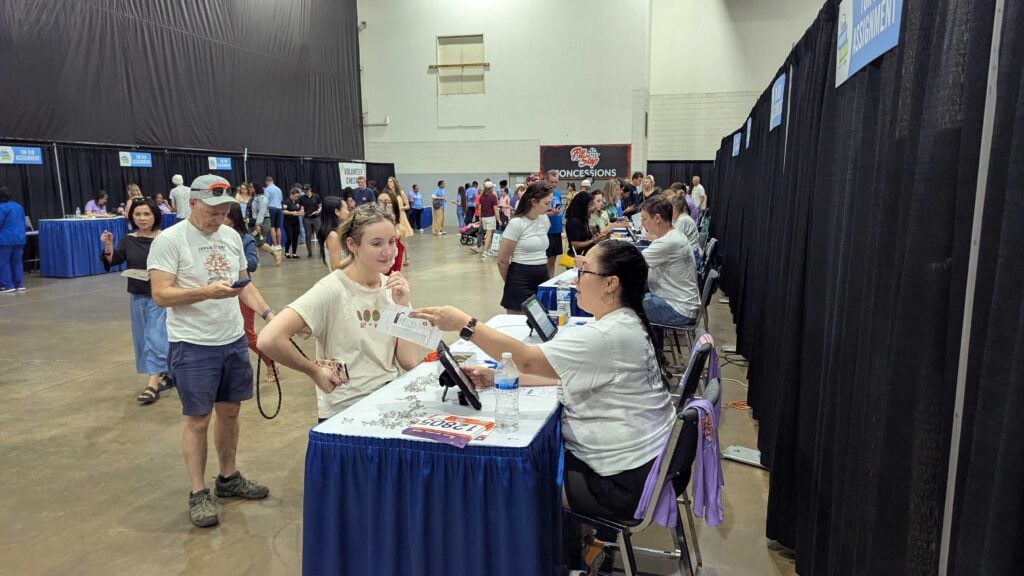
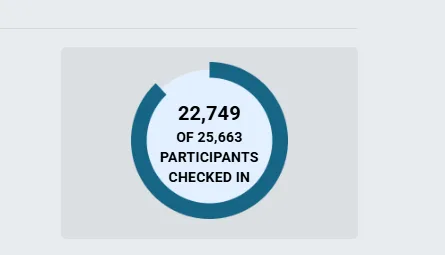
At Crescent City, GO Race Productions and PrimeTime Timing deployed roughly 30 RaceDay CheckIn stations on iPads, plus six to eight standalone kiosks for on-site registration. At Monument Avenue, they ran 38 stations. Volunteers were trained on-site at every shift change, and every dynamic bib assignment flowed straight back to RunSignup for use everywhere else.
The check-in app remains the best feature that RunSignup came out with. Hard stop. It’s just so intuitive. — PrimeTime Timing
Label Printing for T-Shirt Pickup and Youth Safety
Monument Avenue used RaceDay CheckIn’s label printing for both the main 10K and the youth event. Adult labels printed name, age, and sex to confirm identity and speed T-shirt pickup at the expo exit. Youth labels carried emergency contact info on the bib — a safety win the race team specifically requested. A nice side benefit: because labels only print after a bib assignment is saved, the printer doubles as real-time confirmation that the record made it to the database.
RaceDay Scoring as the Primary Scoring Platform
RaceDay Scoring was the primary scoring platform at both events, with secondary platforms running in parallel for redundancy. Crisp and Sean work side by side to provide dual scoring of these larger events. One of the benefits of having two experienced timers together is their ability to divide up responsibilities, talk through any challenges and data inconsistencies, and to be a sounding board for each other throughout the rapid fire hours of timing.
A few highlights at this scale:
- Custom divisions and reports. Monument Avenue ran reporting for collegiate, wheelchair, non-binary, and a local division built around 170 different zip codes — all configured inside RaceDay Scoring. Crescent City scored a special award for the first 500 male and 500 female finishers, validated to 100% accuracy.
- Split timing at scale. By the time the first finisher crossed, the system was already processing roughly 100,000 reads across the start lines, splits, and finish — with a separate race running simultaneously.
- Unknown bib resolution. As often happens, mistakes can be made during the packet pickup. However, because RaceDay CheckIn, RunSignup registration, and RaceDay Scoring stay in continuous sync, reassigning a bib post-race takes a couple of minutes and the result appears online shortly after. So, issue resolution became an easier process than it would have been.


Real-Time Results and Text Notifications
Both races used RunSignup’s text and email result notifications. At Monument Avenue, a few hundred thousand notifications went out within five seconds of participants crossing the finish line — using a custom message written by Sports Backers. Participants had their finish time on their phone before they reached the post-race festival.
Live Finish-Line Video, Tied to Results
GO Race Productions produced a live YouTube stream of finishers at both events, complete with branded overlays, sponsor logos, and on-screen finisher names — tagged to each participant’s result so fans and runners can watch the moment they crossed the line. A favorite with race directors for both the runner experience and the sponsorship upside.
Data Flow and Platform Integration
One of the strongest stories from these two events is how data moved across the stack — fast, accurate, and accessible to other tools. RaceDay CheckIn pushes bib assignments up to RunSignup; the RunSignup API makes participant data immediately available to RaceDay Scoring, the team’s custom apps, and to third-party platforms like Race Result, which was used to drive their finish-line selfie boards. Because RunSignup’s integration with Race Result is built into the platform, participants checked in at packet pickup were immediately available on the selfie board interface — no batch sync, no separate import step.
We had a clock on the lead vehicle that was linked to scoring — so when the gun went off, it started the clock on the pace car. The sponsors riding in the car didn’t have to hop out and push a button. — GO Race Productions
Big Races as Benchmarks for the Whole Platform
The vast majority of races on RunSignup land in the 200- to 5,000-participant range. Large-scale events like Crescent City and Monument Avenue are different: they expose patterns — in processing, in connectivity, in workflow ergonomics — that don’t surface at smaller scales. That’s why RunSignup treats these opportunities as benchmark milestones, a chance to measure where the platform is on its journey toward serving the largest endurance events and to feed what’s learned back into the product for every race director and timer.
RunSignup also sent a member of the RaceDay team on-site at Monument Avenue — not as a fix-on-the-fly resource, but as an observer. Many of the small “quirks” that timers work around in the moment never get fully articulated after the fact. Having a developer watching the system run at 28,000 participants turns those quirks into concrete tickets that improve the product for everyone.
Having Michael Chisolm from the RaceDay team there meant he could see the things in the wild that are so hard to articulate after the fact. Both teams — RaceDay Scoring and Race Result — sent someone, and both walked away with notes that go back into the product. That energy is what makes the difference at this scale. — GO Race Productions
Best Practices for Timing Larger Events
When asked what advice the partner timers would share with other timers stepping up to large events, their top suggestions include test relentlessly, structure your team for division of labor, and build redundancy at every layer. They go deep on the redundancy playbook — gear, people, connectivity, and the rest. Sean not only times these events in duplicate, he evaluates all finisher with FinishLynx. Crisp and Sean a applied clear division of labor with Sean on links/evaluations of top finishers and Crisp on TCP connections, disqualifications, drops, and scoring.
Go Race Productions and PrimeTime Timing use overlapping equipment and teams to ensure essential failsafes are in place. They apply a comprehensive approach combining their talent and equipment by deploying joint redundancies in software, hardware, and personnel. This approach is an integral part of their large event practices.
The moment you get overconfident is the moment you’re going to have problems. Back up. Back up. Back up. And don’t ever assume things are going to go right. Prepare for them to go wrong. Have redundancies for every aspect of operations so if problems arise they are easy, seamless fixes and don’t blow up the whole day. — PrimeTime Timing
Key Takeaways
- RaceDay CheckIn, RaceDay Scoring, and the RunSignup API handled two of the largest dynamic-bib 10Ks in the U.S. across a two-week window — with tight data flow between every layer.
- Platform integrations — including with Race Result — let teams add high-value race-day features like selfie boards without rebuilding the data pipeline.
- Custom divisions, live results, label printing, text notifications, and bib-tagged finish-line video scale the participant experience to the event.
- Large events require a comprehensive redundancy strategy. From two senior timers to redundant hardware on the field, preparation is essential to delivering quality events.
Learn more about the products featured in this case study: RaceDay CheckIn, RaceDay Scoring, RaceDay Real-Time Suite.