

Every race director wants more registrations, but “just market it more” isn’t a plan. At RunSignup University 2026, Bryan Jenkins walked race directors through a session on how to create a marketing plan — one with pricing strategy, referral programs, community partnerships, and loyalty incentives that all work together.
Below, we’re breaking down the key takeaways from that session.
What Makes Your Race Special?
Before you touch pricing or referrals, get honest about your races biggest strength. Is it:
- Great medals and swag
- A social event with a big afterparty
- A family-friendly day
- A competitive field with strong finishes
- An impressive course or landscape
- A delicious post-race spread
Whatever you’re thing is, your marketing should lead with that — and your photos and videos need to show it, they’re with 1,000 words. If your best asset is your course scenery but all your marketing photos are logos and flat lays, you’re burying the lead.
Pricing: Make Every Increase Do Double Duty
Price increases shouldn’t just happen in the background — they should give you a reason to communicate with your audience, Think of your pricing in three phases:
- Early Bird: rewards early commitment and gives price-sensitive runners an entry point
- Mid-Tier: where most of your registrants will land, and where you may run one or two price increases depending on how long registration is open
- Late Registration: higher pricing that nudges stragglers to register sooner next time and boosts revenue closer to race week
The most important rule: keep it simple. Runners shouldn’t have to do math to figure out the best day to sign up.
From there, pick one or two discounting strategies – not all of them. Options include:
- General: time-based increases, tiered increases, coupon codes
- Targeted: age-based pricing, membership discounts
- Register Together: multi-person pricing, group/team pricing, referral rewards
- Loyalty: multi-event discounts, multi-race bundles, loyalty programs
Referrals: A Program that Runs Itself
Referral programs are one of the most efficient ways to grow registration, and the data backs it up. Across a review of 100 referral programs on RunSignup:
Here’s how it works: a registrant gets a personalized URL to share. When someone registers using that link, the original registrant gets credit — and once they hit your reward threshold, they’re automatically rewarded.
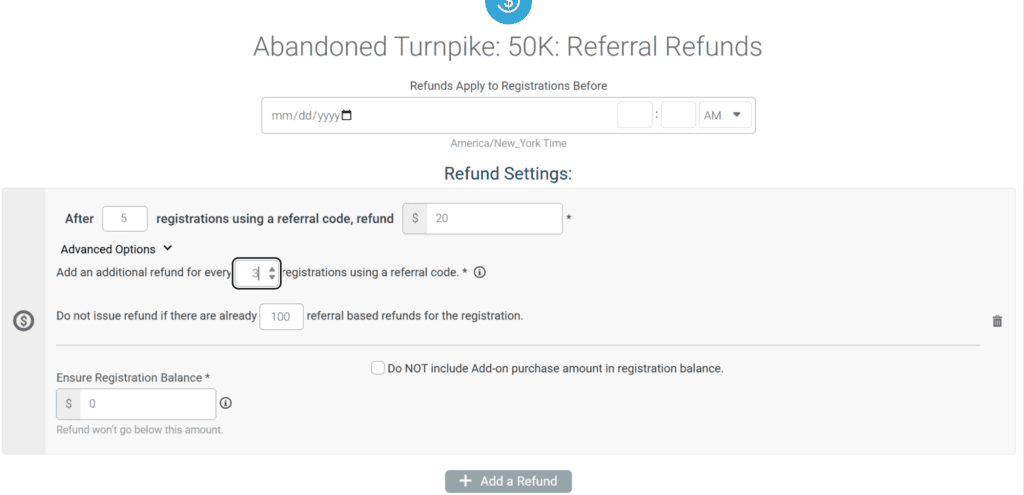
Interestingly, multi-tiered referral programs consistently outperform single-tier ones. Races with multi-tier setup saw 8.6% of registrants from referrals (vs. 7.8% for single-tier) and a higher share of new-to-race registrants (76/.7% vs 72.5%).
There’s no single “right” referral setup — it depends on your goals:
- Standard setup (5 referrals = $20, no additional refunds): low overhead, consistent 5-10% of registrations from referrals, cost per acquisition around $1.19
- Higher rewards (5 referrals = $25, refund every additional 5): built for growth, pushes referral registrations to 18%+, cost per acquisition around $2.39
- More frequent, smaller rewards (1 referral = $2, capped at $10): encourages more people to share at all, drives referrals from 8.6% of registrants (nearly double the standard setup)
- Low-cost testing setup (5 referrals = $10): keeps costs in check at $0.57 per acquisition while still testing the waters
- High-ticket events (4 referrals = $100, scaling up to $250): makes sense for races with high price points where a bigger incentive still pencils out
Whatever setup you choose, the programs that work best don’t rely on the automated post-registration pop-up alone. They promote the referral program on the website, in email, and on social media.
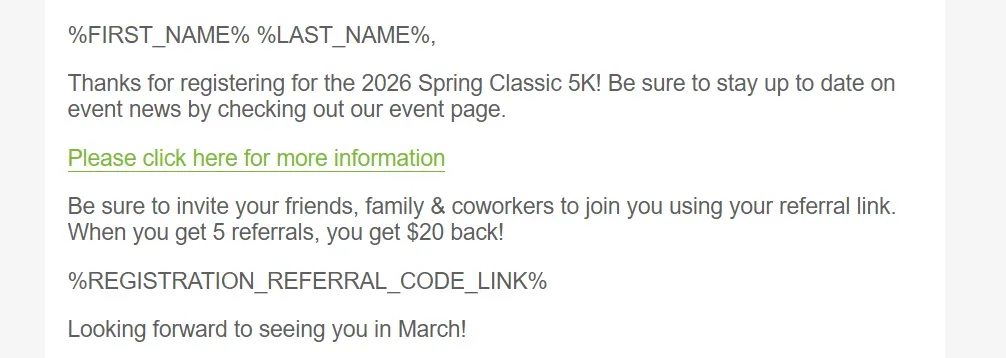
Automated Registration Follow-Up Email
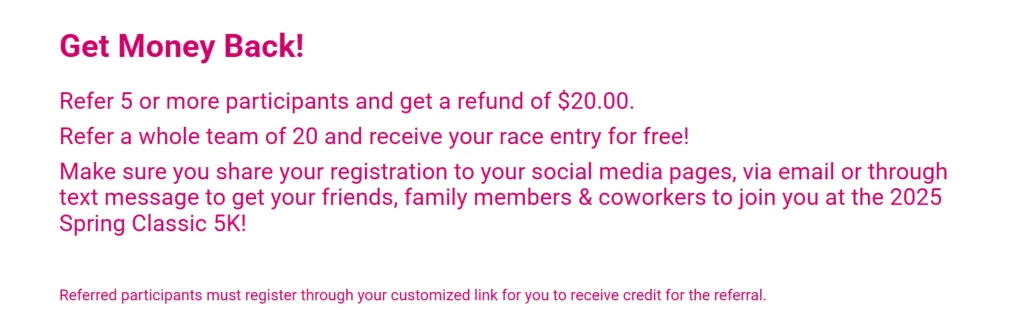
Race Website
Community: Turn Local Relationships into Registrations
Referrals aren’t the only way to grow through word of mouth. The session covered three community-building levers:
- Influencers and ambassadors. Local, engaged micro-influencers tend to outperform outsiders with large followings. Set clear expectations upfront — how often they’ll post, what style, and what they’ll get in return (discount codes, free entry, cash, etc.). To track their impact, you have three options: a custom referral code (easy, but ties into your existing referral refund rules), a custom source tracking link (shows both views and registrations in RaceInsights, though it’s last-touch attribution), or a shareable coupon code (adds a registration incentive, but means giving a discount).

Referral Codes

Source Tracking

Coupon Codes
- Running clubs. Reach out in person when possible — clubs get a lot of race promotion requests, so showing up matters. You can offer a discount to all RunSignup clubs, a discount to one specific club, or simply promote joining a club you already partner with.

- Groups and teams. Whether social or competitive, teams are a double win. This year, they give people a reason to recruit friends to join. Next year, people who raced with friends are more likely to come back. It’s no surprise that 31% of participants join a team when one is available. Sweeten the deal with automated group discounts or non-financial perks like a team tent or reserved parking.

Groups/Teams

Group Size Refunds
Loyalty: Bringing People Back Is Cheaper Than Finding New Runners
Returning participants are your cheapest registrants to win back — so reward them for it. A favorite approach from the session: multi-use reversed entry with loyalty list.
Here’s the idea — give past participants a special link with a discount tied specifically to them (so it can’t be shared or copied). You can tier it based on history for example:
- $20 off for runners who’ve joined 5+ years
- $10 off for runners who’ve joined 3+ years
- $5 off for last year’s participants with fewer than 3 total races
Other loyalty options include early access to registration, guaranteed entry programs, membership programs, and ambassador programs.
Put it Into Action: Website, Email, and Old-School Martketing
A great strategy still needs to reach people. A few ways to put your plan to work:
- Your website: Add homepage sections detailing your referral program, highlighting partner running clubs, and calling out current discounts. Use dynamic components like a live price-increase countdown or a team leaderboard so your messaging stays current without manual updates.
- Email: Automate a registration follow-up email to prompt sharing (2-3 per person, max), and send reminders ahead of price increases to nudge both current and past participants. Don’t forget manually scheduled emails that sell what makes your race special — not just “register now.”
- Old school: Neighborhood signage, flyers at gyms and community centers, and local media still work. Add a custom source tracking QR code so you can measure what these efforts are actually driving.
- Analytics: Use RaceInsights to track page views, registrations, and transactions, and attach costs to see true ROI. Since RaceInsights uses last-touch attribution, pairing it with GA4 and social platform analytics gives you the fullest picture.
Build Your Schedule
Once you’ve made decisions across pricing, referrals, community, and loyalty, map them onto your registration timeline: launch, mid-cycle, and late registration. If your plan requires constant emails to keep up with all your promotions, that’s a sign you have too many running at once for the length of your registration period.
Get the Worksheet
Want to build your own plan step by step? Download the worksheet from the RunSignup University session below — it walks through each section covered here, from positioning to pricing to your full promotional schedule.