

Customer Snapshot

- Events: Full Marathon, Half Marathon, 10K, 5K, Kids’ Race
- 2026 Registered Athletes: ~11,000 (largest year in race history)
- Race-Day Participants: ~10,000
- 2027 Blitz Sale Result: 1,300+ registrations — a 50% year-over-year increase and the largest Blitz sale in race history
About the Salt Lake City Marathon
The Salt Lake City Marathon is one of Utah’s premier endurance events, drawing runners from across the country to a course that showcases the best of Salt Lake — from iconic neighborhoods like Federal Heights to the Utah State Capitol. Now in its 15th year under Race Director Steve Bingham-Hawk, the race has spent the last decade rebuilding into one of the most respected marathons in a competitive Utah endurance market.
“This year was our biggest ever — about 11,000 registered athletes, with roughly 10,000 participating on race day,” Steve said. To pull off an event of that size — and turn race weekend into the launchpad for an even bigger 2027 — the team leaned on the full suite of RunSignup’s RaceDay tools.
The Challenge: Bigger Race, Higher Stakes, Less Margin for Error
As the Salt Lake City Marathon grew into the largest event in its history, the operational demands grew with it. The team needed to:
- Check in more than 10,000 participants and 80+ volunteers per shift across 20 kiosks
- Score over 111,000 raw timing reads cleanly and accurately
- Keep announcers, the info tent, race command, and every staff device connected through a single resilient network
- Manage tight inventory of medals, bibs, and swag against a constantly shifting mix of registrations, deferrals, and transfers
- Launch 2027 registrations seamlessly on race day to capture renewal momentum
On top of all that, the race had outgrown its previous timing platform. After years on Chronotrack and Athlinks, the team made the call to move scoring entirely onto RaceDay Scoring. Race day would be their first real-world test at scale.
The Solution: A Connected RaceDay Stack from Check-in to Results
RaceDay CheckIn App for Participants and Volunteers
The team ran 20 kiosks across packet pickup — 13 tablets running the RaceDay CheckIn App and 7 Chromebooks on web check-in.
Since I switched to RaceDay CheckIn, we get a lot more check-ins per hour than we did with web check-in alone. And it’s more accurate. The check-in app is really foolproof. — Salt Lake City Marathon
That accuracy showed in the numbers. Across thousands of check-ins, lead timer Soren Larson saw only three bib swaps — one of which was simply two friends who had put on each other’s bibs.
The team also used RunSignup’s free RaceDay CheckIn App to power their volunteer incentive program, checking volunteers in at orientations, packet-pickup shifts, and race day to track participation and award loyalty points. “That would be impossible without the check-in app,” Steve said.


Based on this year’s experience, the team plans to phase out Chromebooks and move to a tablet-only kiosk setup in 2027 to unify the hardware infrastructure.
RaceDay Scoring at Scale — and a Custom Course Monitor
Switching to RaceDay Scoring was the biggest technical change of the year. The platform handled more than 111,000 raw timing reads and ran a battery of data checks that flagged runners on the wrong course before they even reached the finish line — meaning results were already clean by the time participants arrived at the results tent.
It was one of the easiest days I’ve had at that volume. — Lead Timer
On top of RaceDay Scoring, the team built a lightweight Course Monitor app that pulled an auto-saved export from RaceDay Scoring every minute and refreshed a sharable dashboard on a three-minute sync cycle. The dashboard answered the single question every race director hears in the final hour: how many people are still on course?
It answered the million-dollar question that gets asked 500 times in the last half hour. And it gave us real data to make hard calls — at one point we were down to 25 half-marathon medals left with 23 runners still on course. It was that close. The data gave us peace of mind. — Race Director
Mobile Timing for Announcers, Splits, and Start Lines
The Salt Lake City Marathon was one of the first major events to use the new RaceDay Mobile app’s Announcer Mode, taking a live data feed over the local network using the line-by-line view. With more than 10,000 finishers crossing the line, it was a meaningful endorsement of the new tool.
The announcer screen was effortless. In past years, it’s been challenging— complex software, hardware not connecting. This year, it just worked. — Race Director


Mobile timing was also used by start-line and split operators to confirm the first runners through each checkpoint, helping the team catch any potential time-sync or drift issues across the course in real time.
A Network Built for the Whole Operation
A reliable race-day stack depends on a reliable network — and the team’s network lead built one. The infrastructure covered not just the finish line but the entire post-race area, the info tent, and every staff device the check-in team needed.
Timers aren’t just responsible for results anymore. We’re responsible for the backbone of the announcer, the staff at race command, and the end-user experience. It was one of the best networks I’ve ever been on at a race. — Lead Timer
Dual-Use QR Codes on Bibs
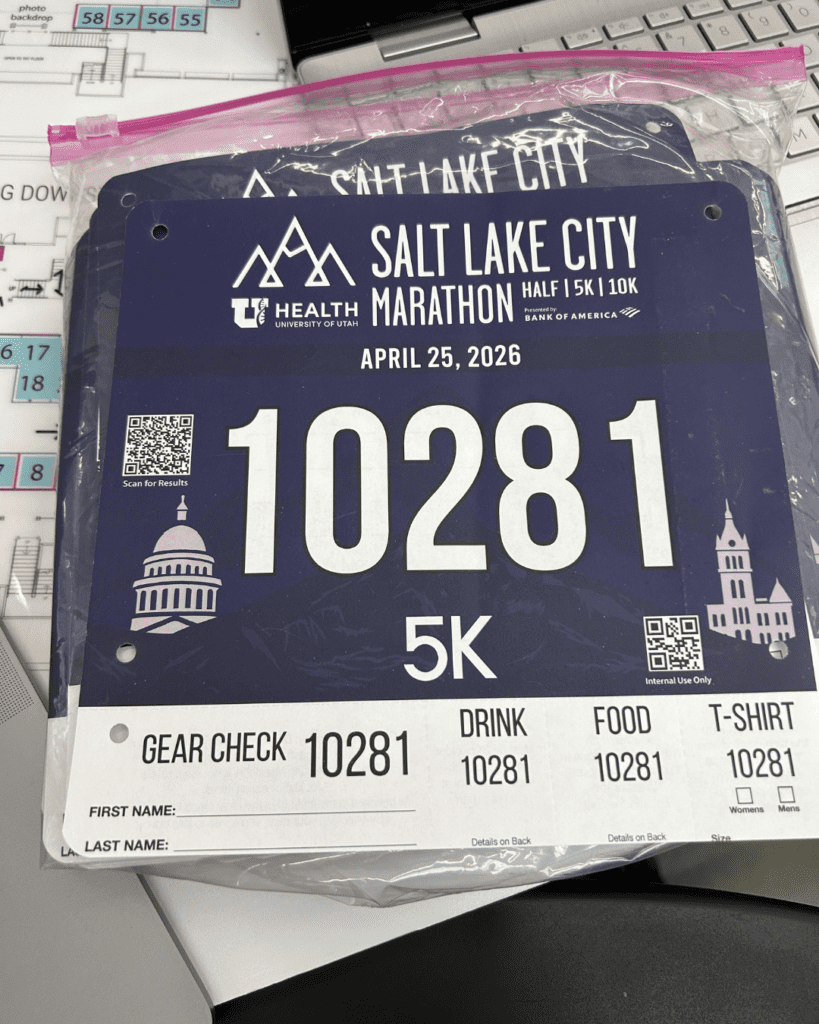
Every bib featured two QR codes: a small admin-only code for quick check-in, and a participant-facing results QR code that also doubles as a check-in code through the RaceDay CheckIn App. The dual-use format would prove critical later in the day, when the team faced an unexpected challenge.
A Record-Breaking Blitz Sale, Run from Inside the Current Race
The team’s most striking commercial win came from how they used race day itself to launch 2027 registration — what they call the Blitz Sale. Within the 2026 race in RunSignup, they pre-built 2027 events in private mode, organized them under a single tile using event grouping, and even kept the previous year’s sold-out events visible to trigger FOMO. Promotion included QR-coded 2′x3′ coro boards across the event site, social media, the announcer script, and a series of email blasts using event-size pricing that closed Sunday night.
The numbers tell the story: 1,300+ Blitz sign-ups for 2027 — a 50% jump over the previous year, and the largest Blitz sale in race history.
The way the team transitioned during race day to 2027 Blitz pricing — the messaging, the announcers, the visuals — was one of the most elegant transitions I’ve ever seen. — Lead Timer
A few of the team’s tips for race directors trying this themselves:
- Build next year’s events in private mode until the moment you want them live — that way registration can stay closed but the events are ready to go.
- Set an alarm to remove the private codes at the exact moment you’re ready to open.
- Use event display options and event grouping to organize events by year and color code next-year tiles distinctly from current-year ones so participants don’t accidentally register for the wrong year.
- Add transfer blocks to prevent participants from moving from this year’s race into next year’s.
Challenges Solved Along the Way
A Bib Redundancy Plan That Paid for Itself in Peace of Mind
After running short on certain bibs the year prior, Steve put together a redundancy plan. The team over-ordered bibs across every event and purchased a stockpile of generic, event-agnostic bibs in black with gold accents — designed to be quickly relabeled into any event’s color-coded system.
When the Website Went Down, the QR Codes Saved Race Day
In the middle of race day, the team’s WordPress site was taken down by a bot attack. To stop the traffic they put up a firewall, which then locked the site for further edits. Elisabeth managed inbound participant messages by simply directing them to the live RunSignup site. Most attendees never knew there was an issue.
Thankfully, we included a QR code on every bib that linked to each participant’s individual results page on RunSignup. If we’d been pointing people to a results page on our WordPress site, we would have been in real trouble. — Race Director
The incident — combined with years of WordPress plugin maintenance burden — was the final push for a decision the team had been weighing: a full migration to RunSignup Websites. The shell of the new site is already underway.
The Results
By every measure, 2026 was the Salt Lake City Marathon’s best year on record:
- ~11,000 registered athletes — the largest year in race history
- 10,000+ finishers scored cleanly through RaceDay Scoring, with over 111,000 raw timing reads
- 1,300+ Blitz registrations for 2027 — a 50% year-over-year increase and the highest ever
- Sold out across every event based on swag inventory
- 20 active check-in kiosks moving thousands of participants through packet pickup
- Zero medal shortfalls at the finish line, with real-time data driving every cutoff decision
- One of the first major races to deploy RaceDay’s mobile timing announcer mode
What’s Next for the Salt Lake City Marathon
The team is already mapping the path to an even bigger 2027:
- Full migration to RunSignup Websites, replacing the legacy WordPress site
- Continued use of RaceDay Scoring, Mobile Timing, and the RaceDay CheckIn App as the operational backbone
- Adding race-day packet pickup as a paid option — a small revenue add and a nudge for earlier check-in


Key Takeaway
The Salt Lake City Marathon’s 2026 success wasn’t a single product win — it was the result of years of progress and improvements along with a connected RaceDay stack working in concert. Scoring, check-in, announcer mode, course monitoring, and renewal-at-the-race all ran off one platform, supported by smart infrastructure planning and a team willing to try new tools at scale.
It was a lot of upgrades for us — and to see something we were so unfamiliar with run so flawlessly felt great. — Race Director
If the names Steve Bingham-Hawk, Elisabeth DellaRova, and Soren Larson sound familiar, that’s because they’re part of the RunSignup team. Seeing them choose to power the race with the very platform of tools they help others to use is one of the strongest endorsements we could ask for — when the people who know the tools best stake their biggest event on them, it speaks for itself.